Dry Cutting Is a Diagnostic, Not a Gimmick: What Japanese Stylists See Before the First Snip

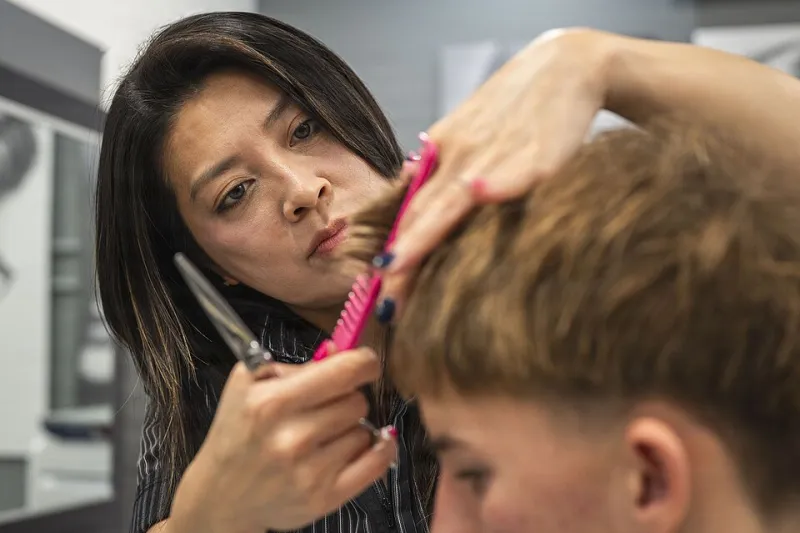
Photo: Japanese hairstylist dry cutting wavy curly hair in salon, via phoenixmassagevancouver.com
Walk into many Japanese salons and the first cut may happen with your hair dry. Not damp, not smoothed down with a comb and a spray bottle, but dry: falling the way it actually falls on a Tuesday morning when you have not tried very hard. That is the appeal. The shape looks lived-in because the stylist is cutting the life the hair already has.
But dry cutting is not magic. It is a diagnostic. And like any diagnostic, it depends on whether the person reading the hair knows your texture, your shrinkage, and your routine. When it works, it is excellent. When it goes wrong, it goes wrong quietly, and you find out after the first wash.
Why dry cutting looks so precise
Wet hair lies. It stretches, clumps, and hides the small things: a cowlick at the crown, a patch of density behind the ear, the way a wave kicks out at the jaw. A wet cut gives a clean baseline. A dry cut gives information.
Japanese stylists often use that information to build airy layers, soft face frames, and shapes that do not look like they were carved with a ruler. The scissors are not doing something mysterious. They are responding to the hair in its natural state. That is why the results can look so specific to the person in the chair.
For fine hair, dry cutting can be a revelation. You see exactly where the weight sits and where it collapses. For wavy hair, it can reveal how much the curl will shrink and where a layer will land. For straight, dense hair, it can keep the ends from looking blunt and heavy.
Where it goes wrong for US textures
The trouble starts when dry cutting is treated as a trend rather than a skill. A stylist who is brilliant with straight, glossy Japanese hair may not have the same fluency with tight coils, fine wavy hair, or texture that changes dramatically when wet.
With curly and wavy hair, shrinkage is the big one. A dry cut that looks perfect in the chair can sit completely differently once the hair is washed and styled at home. Layers can disappear. A face frame can turn into a shelf. The shape can feel uneven even though every section was checked.
With fine hair, over-layering is the risk. Dry cutting makes it easy to see movement, and it is tempting to keep adding layers until the hair looks airy in the salon. At home, without a round brush and a blow-dryer, those layers can collapse into stringiness.
With very tight coils, a dry cut can work beautifully, but it usually needs a different approach: cutting curl by curl, respecting the natural spring, and checking the shape after the hair has settled. A stylist who only dry-cuts straight hair should not be experimenting on a texture they do not regularly handle.
And then there is the styling gap. The Tokyo look often depends on a certain amount of daily effort. If you are not going to blow-dry, round-brush, or use a serum and a diffuser, say so before the first cut. A good stylist will adjust the shape. A bad one will sell you a cut that only works with a routine you will never keep.
How to vet a stylist before you book
Do not ask, 'Can you do Japanese dry cutting?' Almost anyone will say yes. Ask better questions.
Look at their portfolio for the texture you actually have. Not just the polished blowouts. Look for dry, natural curls, waves, and fine hair that has been styled simply. If every photo shows straight hair, that tells you something.
Ask: 'Do you dry-cut curly or wavy hair regularly?' Ask: 'How do you account for shrinkage?' Ask: 'Will you cut my bangs dry or wet?' Ask: 'How do you check the shape after it is styled?' These are not gotcha questions. They are the questions a thoughtful stylist already has answers for.
If you can, book a consultation without the cut. Bring a photo of your hair on a normal day, not your best blowout. Ask what the stylist would do differently for your texture. You are not looking for a speech about technique. You are looking for specificity.
What to ask during the consultation
A useful consultation should sound like a conversation, not a sales pitch. Ask where the layers will sit when the hair is dry. Ask how much length will disappear after shrinkage. Ask whether the stylist plans to cut the perimeter first or the interior. Ask what the shape will look like after you wash it and let it air-dry.
If you have fine hair, ask how they will avoid over-layering. If you have curls, ask whether they will cut curl by curl or on the dry shape as a whole. If you have a cowlick, ask how they will work with it instead of fighting it.
And ask to see the shape before the final pass. A good dry cut has checkpoints. The stylist should be willing to stop, let you look, and adjust. If the answer to every question is 'trust me,' trust your instinct instead.
When a wet cut is still smarter
Dry cutting is not the only right way. If you are making a major length change, a wet cut gives a cleaner baseline. If you have very heavy density, wet cutting can help remove bulk before the dry refine. If you are growing out a bad cut or moving from a bob to a lob, the wet cut is often the safer foundation.
A wet cut is also the better choice if you are planning a chemical service, like a straight perm or a major color correction. The hair needs to be read in its most predictable state first. Dry cutting can come after, as a refinement.
For very tight coils, a wet cut or a hybrid approach can be more reliable, especially if the stylist is not used to cutting your texture dry. The goal is not to be loyal to a method. The goal is to get the shape that works for your hair.
The honest version of the Tokyo look
The Tokyo look is not one cut. It is a philosophy: precision, softness, and a shape that looks intentional without looking stiff. Dry cutting is one tool in that philosophy. It is a way of seeing the hair before you change it.
But the best Japanese-trained stylists are not dogmatic. They will tell you when a wet cut is the right call. They will ask about your routine. They will admit when your texture needs a different approach. That honesty is worth more than any trend. If you want the airy shape, find someone who will look at your hair dry, listen to your wash-day reality, and cut accordingly.