Before the Cape Goes On: 11 Questions Japanese Salons Ask—and Why Honest Answers Change the Cut
Photo: Krzysztof Ziarnek, Kenraiz, CC BY-SA 4.0, via Wikimedia Commons
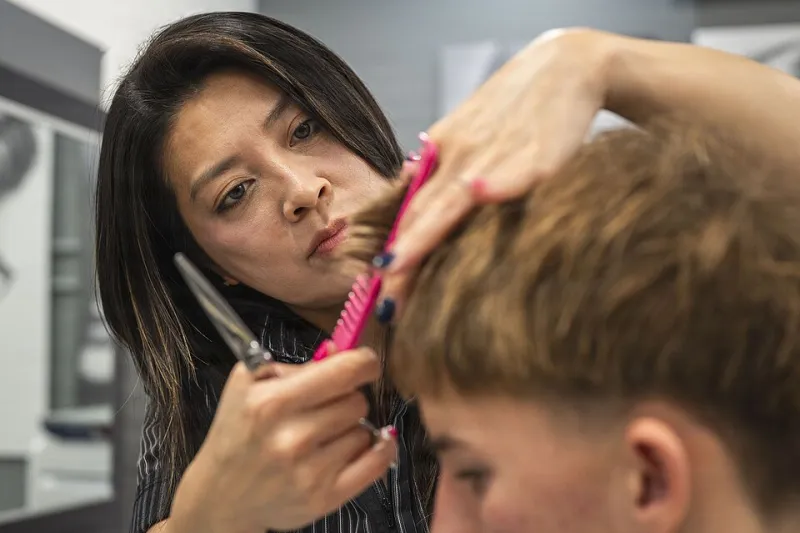
You already have the screenshot. Your stylist has the cape, the comb, and—if the salon leans Japanese—a consultation card. In a lot of Japanese salons, the appointment starts before anyone picks up scissors: a short, structured set of questions about how you live in your hair, not just how you want it to look for one dinner. The card can feel formal to a US client used to a quick 'What are we doing today?' But it is less of a test and more of a map. In 2026, as more Japanese-trained stylists and salon systems show up in American cities, that map is worth learning to read.
Why the Card Exists
Japanese salon consultations tend to treat the haircut as a daily routine, not a one-day event. The stylist needs to know how much time you will realistically spend, whether you air-dry on the subway, how your hair behaves after a workout, and what you hated about the last cut. Small talk is nice. Useful information is better. The card is designed to get both of you out of vague answers like 'something fresh' and into specifics that change the shape, the products, and the price.
The etiquette part is simple: answer honestly, even if the honest answer is 'I will never use a round brush.' A stylist who knows that can give you a cut that works on your actual mornings. A stylist who assumes you will style it can give you a beautiful shape that only works for the first 48 hours.
The 11 Questions, Translated
Here are the kinds of prompts that show up on Japanese-style consultation sheets, translated for US clients and paired with the reason they matter.
1. How much time do you actually spend on your hair on a weekday? Not the time you wish you spent. The real number—five minutes, fifteen, or 'I shower and run.' This decides whether you get a wash-and-go shape or a cut that depends on blow-drying.
2. What does your hair do within 24 hours of washing? Does it flatten at the crown, frizz at the temples, or get greasy at the roots? This is diagnostic information. It tells the stylist where to add or remove weight.
3. Which part of the photo do you want: the shape or the styling? A reference photo usually shows both. Separate them. 'I want this silhouette, but I know the waves are styled' is a much more useful sentence than 'I want this.'
4. What did you dislike about your last three haircuts? Regrets are data. Too round? Too heavy? Grew out badly? The stylist can avoid repeating a problem instead of guessing.
5. How often do you wash your hair, and with what? Scalp habits affect everything from volume to color fade. If you use a heavy conditioner on the roots or a clarifying shampoo daily, the stylist should know.
6. Do you tie your hair back, clip it up, or wear hats often? Tension spots, breakage, and hat flattening are real. A cut that looks great loose can be a nuisance if you live in a claw clip.
7. What is your hair like when you air-dry it with no products? This reveals your natural texture. It also sets a baseline: if you hate your air-dried hair, the cut may need to work with styling, not against it.
8. Are you willing to use heat tools or a round brush? Yes, no, or 'only on weekends' are all valid. The answer changes the cut's internal shape and how much layering makes sense.
9. What is your color and chemical history? Box dye, highlights, keratin, relaxers, and at-home glosses all matter. Be specific about the last 12 months, not just the last appointment.
10. What season are you cutting for? A sleek bob in July may become a hat-and-humidity problem by October. US clients deal with hard water, dry indoor heat, and strong sun; all of that affects wearability.
11. What would make you feel unlike yourself? Maybe you hate visible layers. Maybe a middle part feels wrong. Maybe you never want bangs. Boundaries are not difficult; they are helpful.
How to Prepare Without Overthinking It
You do not need to write an essay before your appointment. A few honest notes in your phone are enough. Take a photo of your hair on a normal day, not just after a salon blowout. Note the products you actually use and the last time you colored or chemically treated your hair. Bring two or three reference images in different lighting, and be ready to say what you like about each one.
If you do not know an answer, say so. 'I have no idea how my hair air-dries; I always blow-dry it' is a perfectly good answer. A good stylist will work with that and ask a follow-up.
The Payoff Is a Better Appointment
The consultation card is not there to make you feel quizzed. It is there to save you from a cut that only works under salon conditions. The more specific you are about your routine, the more precise the stylist can be about weight, length, and placement. That is the quiet strategy behind the etiquette: less small talk, more useful information, and a result you can actually recreate at home.